
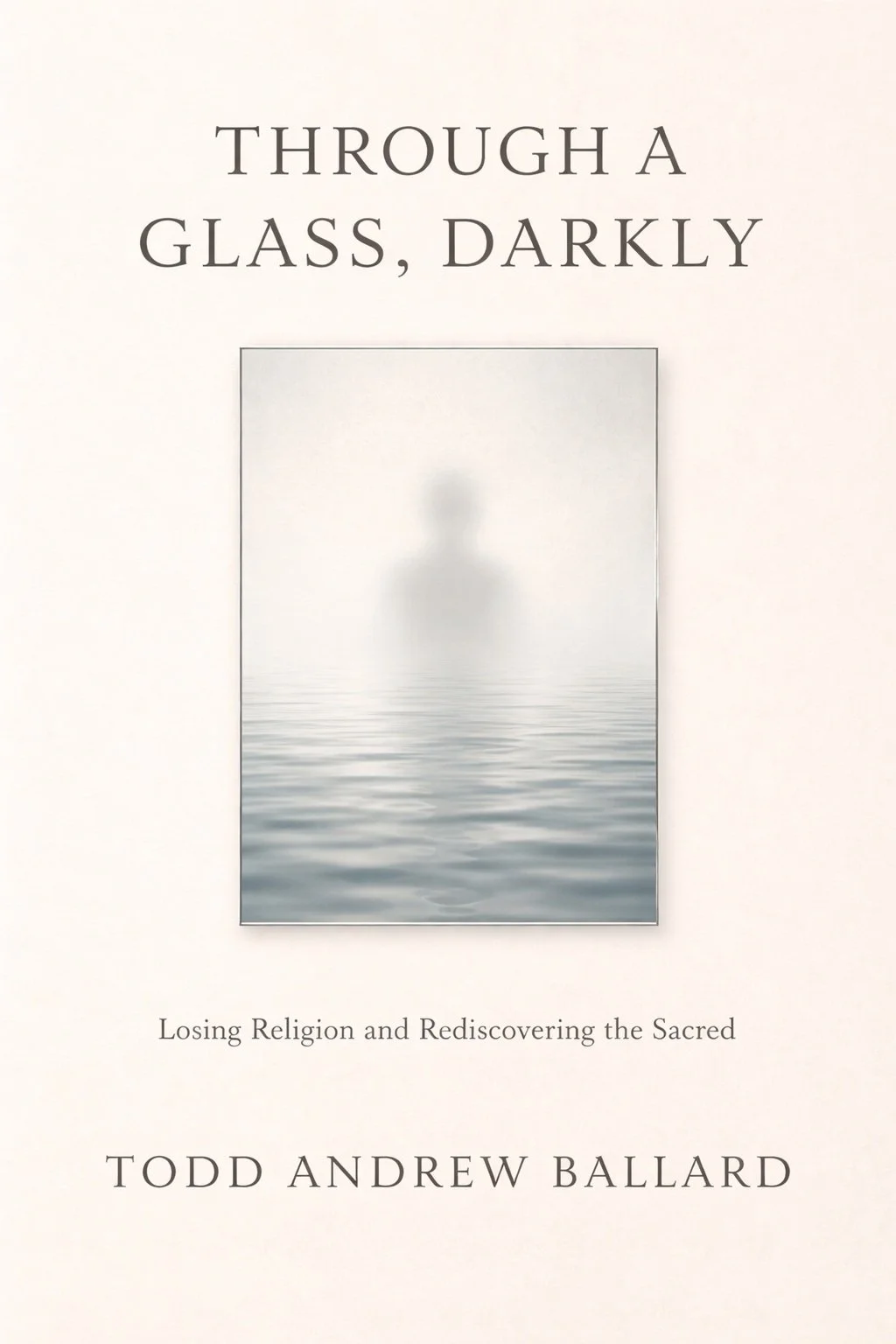
Through A Glass Darkly: Losing Religion and Rediscovering the Sacred
Religion often claims to possess the truth: Follow the correct doctrine. Believe the right things. Join the right institution.
But truth is not something that can be handed to us.
It must be discovered.
Throughout history, spiritual teachers—from the Taoist sages, to the Buddha, to the Christ himself—pointed not to institutions, but to a way of living. A way rooted in compassion, humility, and direct experience with the world around us.
The Way is not something another person can walk for us. Each of us must discover it for ourselves. In Through A Glass Darkly, Todd Andrew Ballard invites readers to look beyond inherited beliefs and explore the deeper spiritual truths that unite humanity across cultures and traditions.
Because the search for truth is not about choosing the right religion, it’s about learning how to live.
Through A Glass Darkly is the story of a life shaped by faith, fractured by religion, and rebuilt through truth.
Raised inside the American church, Todd Andrew Ballard devoted more than twenty years of his life to Christianity—as a believer, volunteer, and educator working within Christian institutions. But when the faith that once gave his life meaning ultimately cost him his career, Ballard was forced to confront a question that millions of people quietly wrestle with:
What happens when the beliefs that shaped your life begin to fall apart?
In this deeply personal memoir of spiritual deconstruction and rediscovery, Ballard explores the painful process of losing religion while searching for something deeper and more enduring than dogma.
Drawing from philosophy, world religions, literature, and personal experience, Through A Glass Darkly traces a journey beyond institutional belief toward a broader understanding of spirituality, compassion, and the universal search for meaning.
This is not a story about abandoning faith.
It is a story about reclaiming it.
For readers who have questioned religion, struggled with belief, or searched for a more authentic spiritual path, Through A Glass Darkly offers a message of healing, courage, and hope.
.
The Story Behind the Song, “City Of Refuge”

In the early 2000’s I picked up a guitar for the second time in my life and learned a few chords, enough to play some Johnny Cash songs. This was when I began writing “City.” (Prior to that, I had picked a guitar up in the mid 90’s and wrote a few songs using power chords, but I never seriously tried to learn to play. Those songs are thankfully forever lost, an absolute embarrassment.)
The original song wasn’t the current chord progression, nor was it the current lyrics. It was basically a rip-off of the song that inspired it, and it was terrible. I was always fascinated with the story about the city of refuge from the Bible. For some reason in my brain, the backdrop for the story was the Wild West. So when I heard Nick Cave’s “City of Refuge,” I was completed blown away. I loved the idea of telling the story in a song. (I had no idea about the gospel song at the time.) As much as I loved Nick Cave’s telling of the tale, I felt it was a missed opportunity. Cave imagined the story (in my mind) from a purely theological lens, capturing the idea of the removing of a sin or a crime, like Lady Macbeth trying to remove her guilt in murdering the King. It was dark, gritty, and in many ways macabre. I loved it, but it wasn’t how I pictured the story at all. All the imagery in my head about the Wild West wasn’t present at all in his rendition. So, I set out to pen my own. I wanted the story to have Biblical proportions, meaning I wanted the song to be as literary as the Bible itself. (That’s what you get when a literature teacher turns songwriter.)
The original title of the song was “These Hands,” maintaining the one image from Cave’s version, that the perpetrator has blood all over his hands. The best stories, songs, and poems are full of metaphor in my opinion, so I set out to let the images tell my tale. The story is told in first person and the author is more of an antihero than a protagonist. Like Cain, he has “shot [his] brother down,” and “his [brother’s] blood cries out from the ground.” The verse reads, “They got nothin on me/ except I’m guilty/ with these hands/ all over these hands. Shot my brother down/ his blood cries out from the ground/ with these hands/ all over these hands.” This is a head nod to both the Biblical tale and Springsteen’s “Adam Raised a Cain.” (Good poets steal!) I couldn’t help noticing the similarities between Cain being cast out East of Eden, and our antihero. The drastic difference being that there could be no forgiveness for Cain, but our hero need only find refuge in the city of freedom.
Springsteen writes: “In the Bible, Cain slew Able, and East of Eden, mama, he was cast/ You’re born into this life paying/ For the sins of somebody else’s past”
This is the theological fallacy of judgement and forgiveness in Christianity. And Springsteen captures it beautifully here. (There are three figures in the Bible who are not afforded forgiveness, and Cain is one of them, though he is not often featured in literature as much as the devil or Judas.) Springsteen, Steinbeck, and Danzig all have put their own twist on Cain.
The second verse brings in the imagery of the Wild West when we see our antihero riding across the desert living by the way of his gun. This song was in the making well before the title track to the album, On The Run, and features the line “I fire my gun/ livin’ on the run.” The line actually inspired me to write my song by the same title and name my original band, On The Run, as well. The verse reads, “Across the desert I ride/ With my gun at my side/ I’m in demand/ My life is in demand. Punishment I bear/ innocence I swear/ I fire my gun/ Livin’ on the run.”
Another one of my favorite images from the Bible is the story of The Christ stopping by the well in Samaria. Samaritans were outcasts at the time of The Christ, and most Jews would travel around Samaria, rather than step foot in the region. In the story, The Christ travels through Samaria and stops at Jacob’s well and offers a Samaritan woman acceptance and forgiveness for her sins. I figured this would be a great place for our antihero to travel to and “take a drink for a spell, this living well, Jacob’s well.”
The image of water, baptism, and death are captured in the well scene. Our hero is also “broken and bruised” not unlike The Christ figure, and like The Christ he feels forsaken–he fears that judgement may overtake him lest he reach the City. The verse reads, “I come to this well/ take a drink for a spell/ this living well/ Jacob’s well. My body is broken and bruised/ My life is spent and used/ I fear the name/ No, I’m not the same.”
Once we arrive at the final scene of the story The Christ imagery appears again, this time coupled with the imagery of harvest, the death of nature, which produces the fruit of the harvest, the seeds–the image of resurrection. “A scarecrow on a cross/ I count my life as a loss/ In death I rise/ to my own surprise. A seed falls to the ground/ I am lost and found/ This shoot comes up from the ground/ without a sound.” Here the image of death and resurrection appear, signifying that our antihero is finally free. The lack of sound associated with his rebirth/forgiveness/resurrection is echoed in the final line of the song. When a plant (shoot) springs up from the ground, it doesn’t make a sound, like the “still, small voice” of Judeo-Christian tradition. Also the line was a direct rip off from Jack White’s “because truth doesn’t make a noise.” (Remember fellow songwriters, good poets steal!)
Whether or not our hero finds true freedom in death or the City itself is up to interpretation. Either interpretation is acceptable.
Though the song is written as verse/chorus/verse, the chorus doesn’t contain any words. This was a device I used throughout, but I wasn’t even really aware of how effective it was until years later. It serves as the voice of the wind throughout the story. Though the lack of sound is mentioned in the culmination or climax of the song, the only other sound in the story is the sound of the gun being fired (death/judgement). The onomatopoeia of the wind; however, is the voice or sound throughout, alluding to the final truth of the tale. In the words of The Christ, “The wind blows where it wishes. You hear the sound of it, but you cannot tell where it comes from or where it goes.” Thus our antihero has reached his final resting place and found his freedom.